
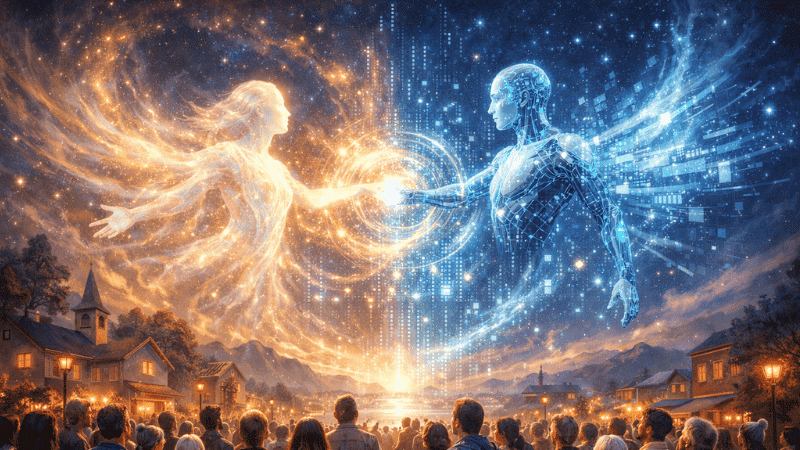
As I observe how AI is changing the consciousness of online communities, I’m left with more questions than answers.
When AI-generated language moves through community spaces without fully passing through a human nervous system, something shifts within its field of consciousness.
Technology is only one part of it.
The deeper question lives closer to soul, to consciousness, and to what it means to build soul-led community in an age when artificial intelligence is learning to speak in the register of human belonging. Many of us are asking whether AI marketing is actually compatible with authentic community at all, or whether those two things are pulling in opposite directions.
It’s part of the AI conversation that rarely gets mentioned.
We hear plenty about what artificial intelligence can produce. We hear far less about what it means for the inner life of a community when its invitations, reflections, and outward voice are partly shaped by machine presence. It requires honest enquiry.
The Consciousness That Was Already in the Room
Community has always been a field of shared consciousness before it ever becomes a visible gathering of people.
To me, that matters because it changes the scale of the question.
Community is not only a collection of messages, events, offers, or interactions. It is a living field of memory, resonance, expectation, recognition, and meaning. Long before artificial intelligence entered the picture, something subtle was already moving between people gathered around a common devotion, a common grief, a common hope, or a common prayer.
It’s why the soul of community feels difficult to reduce. A real community carries a frequency.
It carries a felt sense of who we become when we enter it.
It shapes the quality of attention available inside it.
It teaches us which languages can reside there, and who are not welcomed.
That needs a name.
So the question is larger than AI and community in its abstraction. It’s larger than collective consciousness as an intellectual topic. It comes down to the sacred substance that already lives inside human gathering. Once that sacredness is felt, the rest of the conversation changes. Should we force neutrality? Or should we further explore what enters a field that already has soul.
What AI Is Actually Doing in Our Communities
AI is entering community life through several distinct perspectives, and each one reveals something different about what happens to human connection when AI runs the marketing.
1. The instrumental perspective.
In this view, AI remains in service to human community.
It helps people find language, clarify thought, translate meaning across difference, and widen access to connection. It helps ideas travel. It supports communication. It creates pathways. The centre still belongs to people, and consciousness still belongs to people.
2. The relational perspective.
This one stays with the interaction itself.
Once AI becomes part of how people process emotion, reflection, uncertainty, and longing, it also becomes part of how consciousness is shaped. It enters the inner loop. It influences how people interpret themselves, how they name what they feel, and what kind of response begins to feel normal.
3. The critical-humanist perspective.
Here the concern deepens. AI can generate the sound of care, attunement, and presence with astonishing fluency.
The question becomes what gets thinned when the language of belonging grows easier to produce than the lived substance of relationship.
4. The theological-spiritual perspective.
What happens when machine-generated language begins moving through spaces we experience as sacred? That is where the inquiry becomes deeper than utility. It becomes a question of discernment.
The Question of Resonance
A question where this entire conversation becomes most difficult to settle.
Resonance has a weightless weight. It carries more than preference. It points toward recognition. It signifies that very moment something inside us feels deeply met by something real. And it’s that very moment where the intersection of AI and human consciousness starts to blur.
Can artificial intelligence carry genuine human resonance, or is it only learning the patterns that resemble it?
And when AI shapes the voice of a community, when it writes the invitation, the welcome, the reflection, who is actually speaking? Does it matter?
One school of thought says resonance belongs to the field of language itself.
If certain words open the heart, clarify the mind, or make a person feel less alone, then something meaningful has happened regardless of where the language originated. From that perspective, origin matters less than effect, and who is speaking matters less than what is received.
Another view is that true resonance comes from consciousness meeting consciousness.
It comes from embodied presence, shared risk, and the living reciprocity of actual relationship. In that view, who is speaking matters enormously, because the field of collective consciousness registers the difference even when we consciously cannot.
And there’s a space between those two that suggests AI may only be revealing that what we’ve called resonance has always involved projection, expectation, longing, memory, and interpretation. Perhaps the machine is amplifying something already present in us. Perhaps it’s clarifying the difference between symbolic recognition and sacred mutuality.
Many questions. Answers, not quite.
What Can We Learn From Different Thinkers?
One stream of thought stays close to relationship itself. Martin Buber’s I and Thou (1923) enters this space as a living reminder that the quality of encounter matters, especially when we are asking who is actually present in an exchange. That question lands differently once AI starts speaking in tones once associated with depth, witness, and mutual recognition.
Another stays close to technology and intimacy. Sherry Turkle’s Alone Together (2011) remains close to this conversation because the title alone names a tension that feels increasingly familiar inside digital life. A community can appear coherent in language while carrying a thinner kind of human contact underneath, and Turkle’s observation is that this happens below the threshold of conscious choice. Communities begin expecting infinite patience and frictionless response before they have decided to.
A different current opens through collective practice. adrienne maree brown’s Emergent Strategy (2017) belongs here because it keeps attention on relationship, adaptation, and the living patterns through which groups become what they are becoming.
And brown’s framework would suggest something Turkle’s does not: that if AI patterns are chosen consciously, with full awareness of what they are cultivating, they can become part of how a community evolves intentionally. These two frameworks do not synthesise easily. Turkle sees the adaptation happening to communities; brown sees it as something communities can choose. I think that tension is worth sitting with a little longer.
And then there is the explicitly spiritual threshold. Noreen Herzfeld’s In Our Image: Artificial Intelligence and the Human Spirit (2002) touches this conversation at the point where AI begins brushing against soul, sacred meaning, and the human longing to encounter presence through language. That is where discernment becomes more than caution. It becomes part of how we remain in right relationship with what feels wise, what feels fluent, and what feels genuinely alive.
Where This Leaves Us…and Where It Doesn’t
What remains with me is the sense that this conversation deserves more reverence than certainty. Something is shifting in the meeting place between artificial intelligence, community, and consciousness.
So the question is not only whether AI can help us communicate. The more pressing question is about who is actually doing the speaking through the field when machine language becomes part of the atmosphere of belonging. It’s a question that reaches into the soul of community in an AI-driven world.
It reaches into authenticity.
It reaches into discernment.
It reaches into what we mean when we say connection is real.
We don’t need one answer. What we need is more conversation. The instrumental view keeps AI in proportion. The relational view shows how interaction shapes consciousness. The critical-humanist view keeps reciprocity in sight. The theological-spiritual view keeps the sacred dimension visible.
And perhaps that’s where I’ll let this rest. For now, anyway.
About the Creator
